Death work is life work.
I thought I was learning how to accompany the dying. Turns out, I keep learning more about living.

It’s the right season to finally reflect on this past year—and my work with death.
At the start of the year, just as I was experiencing the death of my relationship as I knew it—with the father of my children, the love of my life—I embarked on an intensive course in death doulaship, or more aptly, compassionate accompaniment.
As life does, it arrived right on time. I’d signed up months earlier, unaware of how precisely it would meet me.
I thought I was signing up to learn how to volunteer—how to sit bedside for the dying. My astro chart is full of death; the eighth house of transformation is everywhere. I’ve long felt drawn to los moribundos and never known what it meant, or how to act on it. If anything, that pull has shown up as anxiety—an anticipation of the inevitable deaths on my path. Those close to me, and as I’ve since learned, those within me.
The entire premise of the course was to come into contact with our resistances and triggers—anything that could keep us from showing up as empty vessels in the presence of death. To hold a clean space for the dying and their loved ones: clean of our own experiences, ideas, judgments, intentions. Because if we can hold death with awakened consciousness, it allows death itself to awaken consciousness in us all.
This was a pivot. I’d thought I was turning toward service work—something outward—only to find myself, once again, in the familiar inner labyrinth of my own soul.
I learned that avoiding hurting the people we love is a form of death avoidance. I didn’t think I related to the latter, but I definitely embodied the former. As a recovering codependent, this revelation blew my mind.
Death is inevitable—duh. I do death meditations often, and the awareness of death around me makes my life richer, fuller of mundane gratitudes, all in service of dying a good death.*
But hurting the people I love? Oh wow. That’s inevitable too. And if I can meet it with the same neutrality I bring to death, might my relationships transform? Yes, Meghan, they will. (I still need to ping my codependency coach, Erika Wright, for her take. It rocked me.)
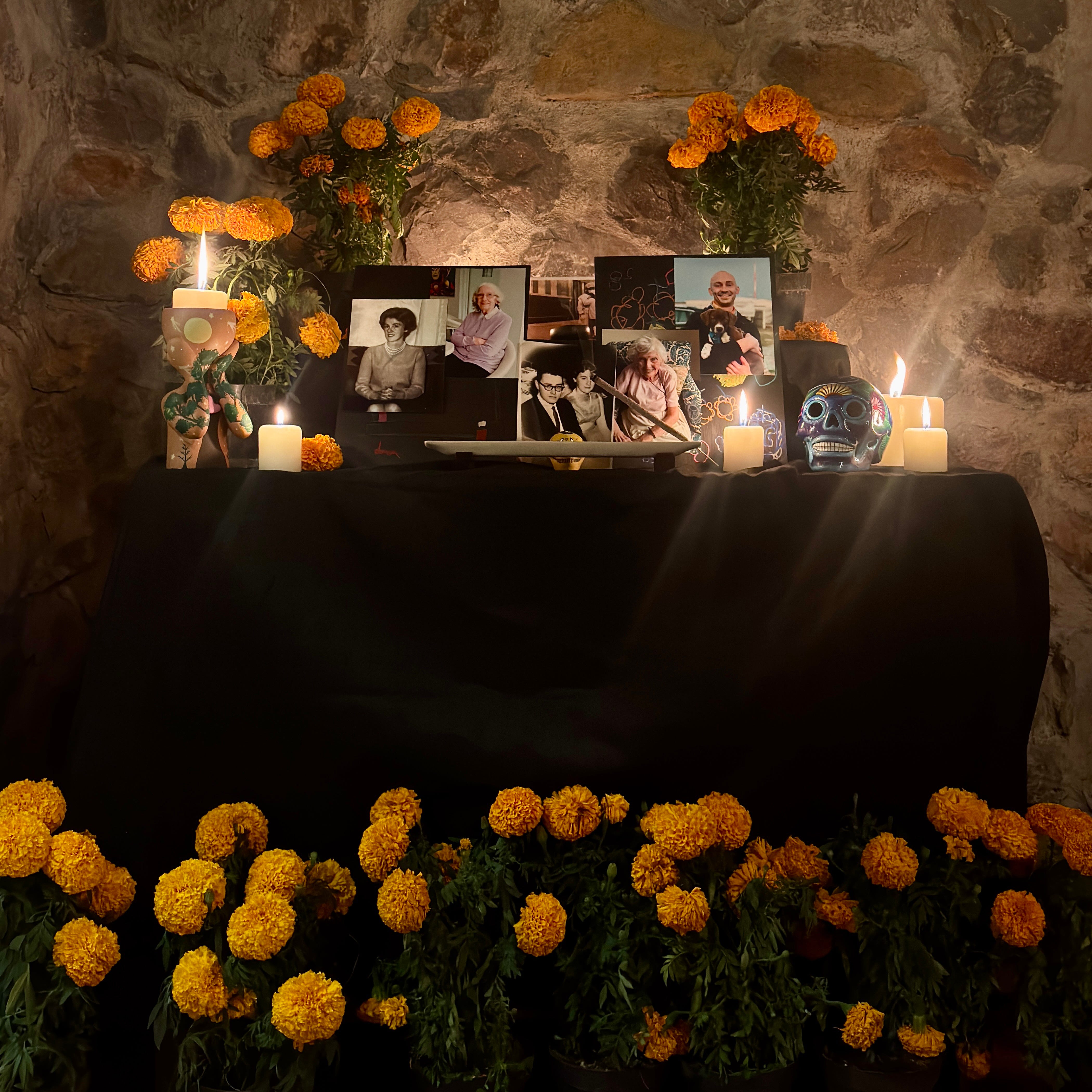
Recently, twelve of us from the course gathered in San Miguel for a six-day immersion. We wrote, cried, mapped every loss in our lives—a cartography of deaths and rebirths—laughed loudly, enacted our deaths, told stories through myth, moved our bodies, spoke with our ancestors, and learned: it’s not about us.
It’s not about me.
Nope. Never.
The work of being with the dying begins and ends there.
There is that. I am not that.
The lessons of death are the lessons for life.
My dead grandmother recently came to me in a waking dream. She hadn’t allowed herself to grieve a traumatic loss early in life, and it shaped every day she walked this earth—and every day I have. These are the cycles we inherit, the unprocessed deaths we live. I can’t begin to imagine what it was like for my mother to live inside that pain, generation after generation.
The messages that came through my grandmother scared me. I felt, viscerally, the currents of pain, fear, scarcity, and anger running through our family line. Awake and asleep—it was haunting. Once, it would have swallowed me whole. But this time, I remembered:
There is that. I am not that.
I’m only beginning my work with death and dying. But what I know now is that it’s teaching me how to live. How to live quiet inevitabilities and neutral truths through a depersonalized lens. It is teaching me how to break the cycle.
“I just want to eat good fruit, tell the truth, and die knowing I broke the cycle.”
—Mike Tyson
*A good death, to me, isn’t about who’s there or how it looks. It’s one where the work doesn’t have to happen at the end—because it’s been happening all along.
Sheesh. This gave me shivers down the spine. Stunning as always. X